

Card skimming blog

Card Skimming: How to Stay Safe!

Are you taking a road trip this summer? Keep an eye out for suspicious card terminals at gas stations and ATMs! Scammers are installing card skimming devices at gas stations, ATMs, and even grocery stores worldwide! Don’t let them ruin your trip! 🚗💳

👀 What to watch out for:

  • Look at the card reader, if it looks suspicious (loose parts, damaged, different colors, or it seems off) do not use it
  • Avoid non-bank ATMs – they’re less secure.
  • Check for fake or bulky keypads.
  • Be extra cautious in tourist areas.
  • Never share your PIN by phone, text, or email — legit organizations will never ask.

🔒How to avoid card skimming:

  • Use mobile pay or tap to pay whenever possible.
  • Use a credit card over a debit card or run your debit card as a credit card if you have the option.
  • Cover the keys when typing in your PIN.

When traveling or even while going about your daily routine, regularly check your accounts. If you spot suspicious activity, turn off your card immediately, and report it to your bank and local authorities.

Juice Jacking Alert

Travel Alert! Juice Jacking!

Are you traveling this summer? Be mindful to protect your phone and other devices. Cyber criminals are using public chargers to install malware on phones and steal data. A single compromised charging port could put your data at risk while you travel.

Quite simply, it’s a cyber attack in which a compromised USB charging station transfers malware to, or steals personal information from, a connected device.48 This threat doesn’t just target phones — any device that charges via USB can be at risk.

Signs you may be a victim:

  • Device is running slow
  • Battery is draining faster than normal
  • Unknown apps suddenly installed
  • “Trust this computer” prompt appears on phone or tablet
  • Error messages
  • Data breaches

How to protect yourself:

  • Avoid public charging stations
    • Airports, hotels, cafes
  • Bring your own charger and cable
  • Use your own portable battery packs
  • Use a USB data blocker
  • Have two-factor authentication enabled

If you have been a victim of juice jacking, please report it to your local or national authorities. Don’t know who that might be? Here’s a great wiki where you can find out!  

Stay safe!

tips and tricks to stay during data breaches

News Alert! Beware of Data Breaches!

Data breaches seem to pop up in the news all the time, but what exactly are they and how do they affect you?

🚨 Data breaches are an event that results in confidential, private, protected, or sensitive information being exposed to a person not authorized to access it. 🚨

If you see a data breach from a company you use, here are tips and tricks to ensure your safety:

  • 🔒 Change your passwords immediately
  • 🌐 Look up the data breach to see what type of information was exposed
    • Based on the severity of the information breached, will require different actions
      • Social Security
      • Email
      • Name and Date of Birth
        • Watch for identity theft, if someone starts using your information report it here!
  • 🔑 Enable MFA
  • 🕵🏼‍♂️ Be on the lookout for social engineering tactics
    • Watch for phishing through emails and texts
    • Do not answer unknown phone numbers and email addresses
    • Do not click on strange links sent over email or text
      • These bad actors may use fear and urgency to get your attention, so make sure to slow down and read any messages sent. 

📱Stay up to date and learn more about cybersecurity by signing up for text alerts here!

CyberFlex Scam Alert for summer subletting

Subleasing This Summer? Watch Out for These Scams!

Every year, students head home for summer break — and many of them try to sublease their apartments to save (or make) some extra cash. But scammers know this too… and they’re taking full advantage.

One common scam we’re seeing? Fake subtenants who use payment confirmation screenshots and “bank verification” tricks to steal money.

Here’s how it works:

A student lists their apartment for sublease.

They get a message from someone claiming to be another student — often with a believable profile — who’s ready to rent right away.

The scammer offers to send a deposit, and follows up with a screenshot of a payment confirmation. But here’s the catch: they say the payment is “pending” and ask the student to send money back in order to “verify the account” or “activate the transfer.”

Once the student sends the money, the scammer vanishes.

🚨 Red Flags to Watch For

  • Requests to send money to “verify” or “unlock” a transfer
  • Sketchy screenshots of payments that haven’t actually hit your account
  • Communication that only happens through DMs or unverified apps
  • Pressure to act quickly without a formal lease or ID check

How to Protect Yourself

Never send money to “activate” or “verify” a payment. If it hasn’t hit your account, it doesn’t exist.

Use trusted platforms with identity verification and built-in protection.

Reverse-image search profile pictures or usernames. Scammers often reuse stolen photos.

Get everything in writing. A formal sublease agreement adds a layer of protection — and can scare off scammers who prefer low-commitment cons.

If You’ve Been Scammed…

You’re not alone — and there are steps you can take. Visit our Resources page to:

  • Identify what kind of scam you experienced
  • Report it to the right platforms
  • Get tips on possible recovery options

Don’t ghost it. Get help.  Stay one step ahead. Follow @gcacyberflex and subscribe to our free scam text alerts to protect yourself and your friends.

Red flags and tips to stay safe from graduate job scams

How to Keep Scammers from Sabotaging Your Job Search

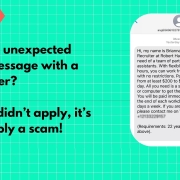
Remote gigs that start right away sound ideal – but they’re also a scammer’s favorite trap. Most students want to have a job lined up before graduation, especially if it’s a WFH opportunity. These fake job offers are designed to steal your personal info (or even your money), in the disguise of a real job. 

We get it – the job market is tough right now. But don’t let urgency cloud your judgment. Take your time. Do your research. Stay vigilant. And remember, if it sounds too good to be true – it probably is. 

Most Common Job Scams:

  • 🚩Advertisements For Jobs on Social Media
    • Many scammers try to get you to apply for jobs that seem too good to be true on social media. This is a quick hack for them to steal your personal information.
  • 🖥️ Virtual Jobs
    • Scammers know remote jobs are in high demand, so they are hiding behind fake job applications waiting to trick you.
  • 💬 Texts or WhatsApp job offers
    • Many job scammers are trying to con you into jobs by reaching out via text and Whatsapp – always research the number first. Most companies do not reach out via text or whatsapp for a job offer if they have not met or heard from you. 

How to Spot Job Scams:

  • ℹ️ They already have your personal info … but you never applied?
    • If a company reaches out and you never sent in a resume—BIG 🚩
    • Scammers often pretend to “recruit” using data they’ve scraped or stolen.
  • 💵The pay seems too good to be true
    • “$1000/week to post on Instagram!” Sounds amazing, right? That’s the point. Unrealistic pay is bait. Don’t bite.
  • 📵 No interview? No Onboarding? No thanks.
    • Legit jobs have a process – applications, interviews, onboarding. If they skip all of that, pay attention! It is probably not real. 

Job Hunting? Stay Smart with these Cyber-Safe Tips: 

  • 👀Do a vibe check (aka Research!)
    • Google them. Check their Linkedin. Real companies leave real footprints online. 
  • 🌐Only apply through the official “https:” sites
    • Sketchy links = sketchy jobs. Use the company’s official site or trusted job boards. 
  • 🚷 Don’t job hunt in complete silence
    • Got any doubts? Run it by a friend, a mentor, or a family member – a second opinion can always save a first mistake! 

Happy Job Hunting! Remember to use these tips to land your REAL dream job. 

March Madness scams blog

Stay Cyber-Safe During March Madness

March Madness isn’t just a paradise for basketball fans—it’s also prime time for cybercriminals looking to cash in on the excitement. With millions of people buying tickets, placing bets, and streaming games, scammers are working overtime to trick unsuspecting fans.

At GCA CyberFlex, we want to make sure you stay in the game without falling for cyber scams. Here’s what to watch out for:

  • Fake Ticket Scams 🎟️

✅ Only buy from verified sellers like the official NCAA site or reputable platforms like Ticketmaster and StubHub.

Think you found a great deal on last-minute tickets? Be careful—scammers create fake resale sites that look legit but steal your money. To avoid getting scammed:

❌ Avoid sketchy resale sites, especially those with deals that seem too good to be true.

  • Betting & Fantasy League Scams 💰

March Madness betting can be fun, but cybercriminals use it as bait to trick you into giving up your money or personal info.

🚩 Watch out for unlicensed sportsbooks offering crazy-good promos—if they ask for payment in crypto or gift cards, it’s likely a scam.

🎲 Stick to legit, licensed betting platforms regulated in your state.

  • Phishing Emails & Texts 📧

Scammers send fake emails or texts pretending to be from the NCAA, sportsbooks, or streaming services. These messages often promise exclusive deals or warn about urgent account issues—but they’re really trying to steal your login or payment info.

🔍 Double-check the sender before clicking on links.

🔒 Never enter personal info on a site you didn’t navigate to yourself.

  • Free Streaming Scams 📺

We all love free stuff, but clicking on sketchy “free” streaming links could cost you a lot more than a cable bill. Many of these sites install malware on your device, stealing personal data or infecting your system.

✔️ Stick to official streaming sources like CBS, ESPN, or the NCAA app.

❌ If a site asks you to download extra software, it’s a red flag.

Protect Your Brackets AND Your Bank Account!

If something seems too good to be true, it probably is. Stay alert, share this with fellow fans, and let’s keep March Madness scam-free!

online dating scam image

Beware of Dating Scams: Cybercriminals Are Targeting Online Daters

We’ve seen a rise in cybercriminals exploiting dating platforms to deceive users and steal money or personal information. These scams often involve fraudsters creating fake profiles on dating apps and social media to build trust before manipulating victims into sending money, investing in fraudulent schemes (like crypto scams), or revealing sensitive data.

How Dating Scams Work:

💔 Romance Scams – Scammers pretend to form relationships and fabricate emergencies or investment opportunities to ask for money.
💸 Crypto & Investment Scams – Scammers convince victims to “invest” in fraudulent cryptocurrency platforms or fake financial opportunities.
🔍 Catfishing – Cybercriminals steal identities or use AI-generated photos to create fake personas and manipulate victims.

How to Stay Safe:

🔗 Watch for Red Flags – Scammers often avoid video calls, rush relationships, and push financial requests.

Don’t Send Money – No legitimate love interest will ever ask you for financial help or investments.
📸 Reverse Image Search – Use a reverse image tool to check if profile photos are stolen from elsewhere.
🔐 Protect Your Personal Data – Never share sensitive details like banking info, passwords, or ID documents.
🔎 Verify Investment Opportunities – Be skeptical of anyone urging you to invest in cryptocurrency or online trading platforms. 

📌 Sources & Further Reading:

If you suspect a dating scam, report it and contact the dating platform being used.

Job Scam blog image

Job Seekers Beware!

As job seekers turn to the Internet to find new opportunities, cybercriminals are finding new ways to exploit this process. One alarming trend involves scammers posing as legitimate employers to trick job seekers into sharing personal information or even paying fake fees.47 These scams can lead to identity theft, financial loss, or the installation of malware on your device.

  • Fake job postings: These may appear on legitimate job boards but often include offers that seem too good to be true, such as extremely high salaries or remote roles with little experience required.
  • Phishing emails: Scammers send emails posing as recruiters, directing victims to fraudulent websites designed to steal login credentials or sensitive data.
  • Fake application processes: Victims are asked to download documents or software that turn out to contain malware.
  • Research the company: Always verify that the company exists by independently checking their official website and contacting them directly.
  • Watch for red flags: Be cautious of employers who ask for payment upfront, request sensitive information early in the process, or communicate only through unofficial channels.
  • Don’t click the links: If a job posting or email directs you to an unfamiliar site, double-check the URL and proceed with caution.
  • Use antivirus protection and DNS filtering: Ensure your devices are equipped with the latest security software to block potential threats, like Quad9.

If you suspect a job posting or recruiter is a scam, report it to the job board, the FTC, or your country’s cybersecurity agency. Staying informed is your best defense against online threats!

Stay up to date on evolving cyber threats — sign up for our text alerts to stay informed. https://gcacyberflex.org/stay-alert/#text-alert

shopping scam alert for black friday

Shopping Scams: 'Tis the Season...

‘Tis the season to shop and not be scammed while shopping for holiday deals online!  Cybersecurity experts estimate that 60% of Americans will be clicking add to cart this year and sophisticated scammers are ready to take advantage and steal your information. Here are 4 scams to look out as you shop the Black Friday/Cyber Monday deals:

  • Scam Ads on Social Media: Social media platforms become hotbeds for fraudulent ads during a shopping event like Black Friday. Don’t be fooled; if you take the bait, the ad will lead you to scam websites that impersonate the genuine brand website.
  • Spoofed Brand Websites: Spoofed websites are a common trap during the Black Friday frenzy. Such copycat websites often mimic popular brands and can appear almost identical to the original. They often offer deals that are too good to be true, and they are!  You likely won’t receive your order but you will lose your money, along with personal and financial information. Once scammers have your details, they can potentially sell them to cybercriminals on the dark web or use them for further fraudulent activities.
  • Gift Card Scams:  Scammers use gift cards to steal your information during the Black Friday shopping period.  Imposing trusted brands, scammers will email you, tell you you’ve won a gift card, and then harvest your personal information to sell on the dark web.
  • Delivery Scams: Waiting for packages to be delivered is one of the best parts of online shopping. That’s why scammers create fake delivery notifications to exploit your excitement to receive your packages! These texts and emails claim to be from customs, USPS, or another delivery service. They state a problem with your order to get you to click on the link provided to receive your package. These links are used to steal your personal information.

cracked video game blog

Stay Alert! Cracked Games Aren't All They're Cracked Up to Be

We’ve seen an increase in cybercriminals using YouTube videos to distribute malware disguised as cracked video games. Cracked games are pirated versions of video games that have been altered to bypass security or licensing restrictions, allowing people to play them for free. These malicious YouTube campaigns trick gamers into downloading files that contain malware, like Vidar or Lumma Stealer, which are designed to steal personal information such as passwords and cryptocurrency. Attackers use compromised YouTube accounts to post these videos and often rely on cloud platforms like Discord and OneDrive to host the malicious files. 

Here are tips to stay safe:

  • Don’t download cracked software: This is a common method for spreading malware.
  • Be skeptical of YouTube videos promoting free game downloads: If a video promises game cracks or cheats, it’s likely a scam.
  • Don’t click on suspicious links: Always verify the source before clicking on any download links.
  • Use antivirus software: Ensure your system has up-to-date antivirus protection to help identify and block malicious files.

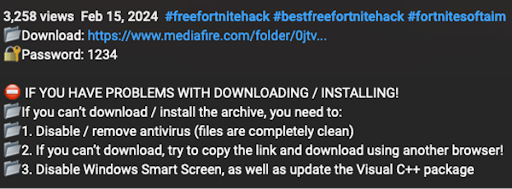
Here’s an example of what you might see43:

If you come across cracked game links, report it to YouTube or the platform being used

Stay safe.

Stay CyberFlexed!